

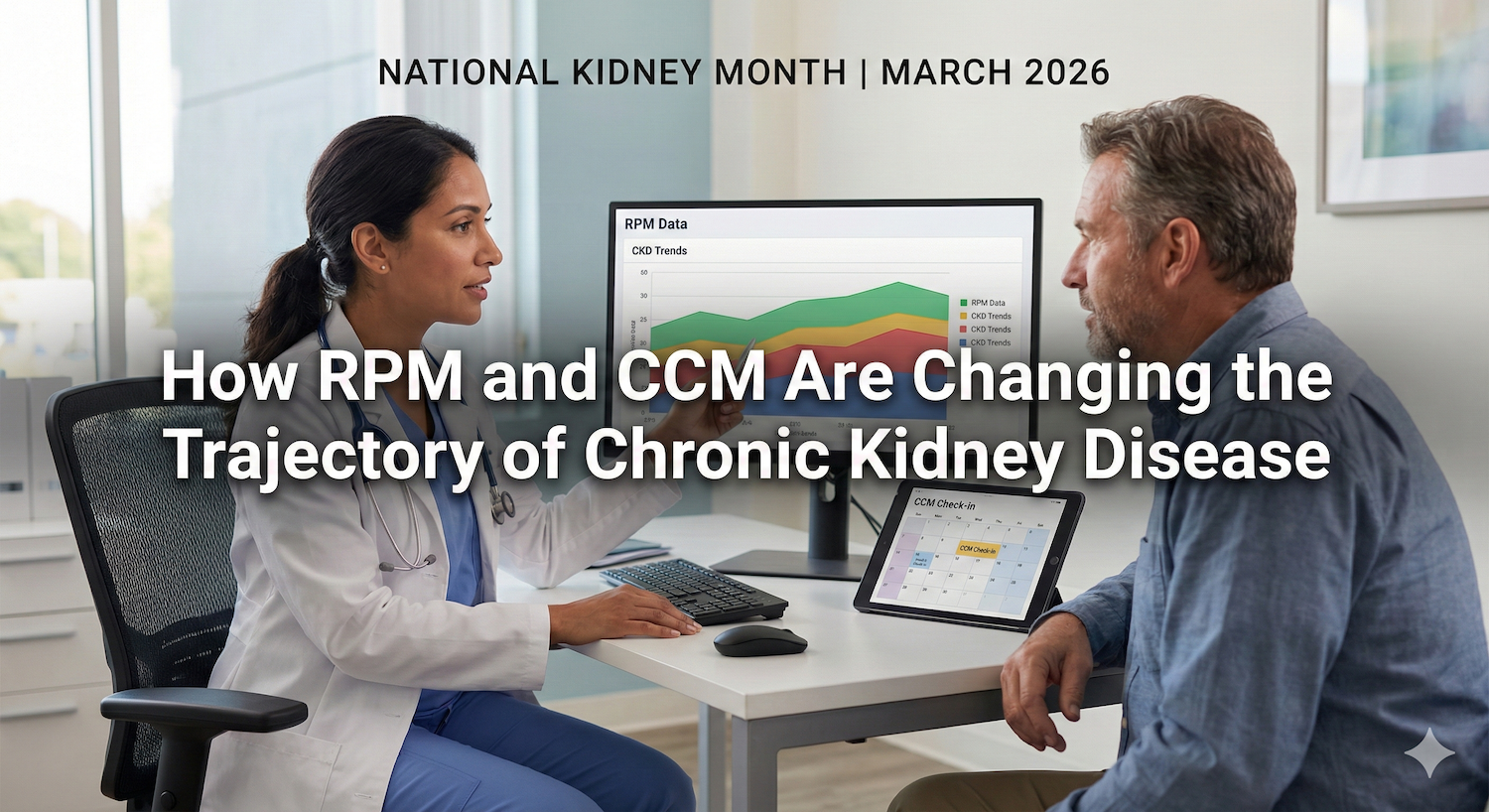

The Silent Crisis in Your Patient Panel
March is National Kidney Month, and it arrives at a moment when the data should give every healthcare leader pause.
Chronic kidney disease affects more than 35.5 million American adults, roughly 1 in 7. It is the ninth leading cause of death in the U.S., it drives nearly $77 billion in annual Medicare spending for beneficiaries 66 and older, and the per-person cost for a CKD patient is more than double that of a beneficiary without it. Yet 9 out of 10 people living with CKD don’t know they have it.
This is not a niche specialty problem. CKD is overwhelmingly a primary care and multi-specialty challenge, because the conditions that cause and accelerate it (diabetes, hypertension, cardiovascular disease) are already sitting in your panel. The question is whether your practice has the infrastructure to identify those patients early, engage them consistently, and intervene before they progress.
Why CKD Demands a Different Approach
CKD is a progressive, five-stage disease. In early stages, there are essentially no symptoms. By the time a patient is symptomatic, significant irreversible damage has often already occurred. Kidney disease rarely exists in isolation. It almost always coexists with hypertension, diabetes, and cardiovascular disease, and these comorbidities accelerate decline when left unmanaged.
The traditional care model, built around periodic office visits, was never designed for this kind of disease. A patient with Stage 2 CKD and uncontrolled hypertension might see their provider every 3 to 6 months. In that gap, blood pressure can climb undetected, medication adherence can lapse, and the disease quietly advances. The 2024 KDIGO Clinical Practice Guidelines emphasize an individualized, risk-based approach to CKD management, including greater emphasis on continuous monitoring and early intervention, particularly for patients with comorbid diabetes and hypertension.
This is exactly the gap that Remote Patient Monitoring and Chronic Care Management are designed to close.
RPM: Continuous Visibility Between Visits
Remote Patient Monitoring puts clinical data in front of care teams in real time, not just when the patient happens to show up. For CKD patients, that means daily blood pressure readings, weight trends that may signal fluid retention, and glucose levels for diabetic patients, all transmitted from the patient’s home to your clinical team without requiring an office visit.
The clinical evidence on RPM for kidney disease is growing. A systematic review published in BMJ Open, examining nearly 10,000 participants across five countries, found that RPM follow-up for home dialysis patients reduced hospitalization days compared to standard care. The review specifically noted that patients on RPM had fewer and shorter hospital stays even when they started with worse comorbidity scores. A separate study documented a 39% reduction in hospital admission rates for patients on automated peritoneal dialysis with RPM, along with a 54% decrease in the duration of hospital stays.
Broader RPM research reinforces these findings. A Michigan Medicine study of over 1,100 encounters across multiple chronic conditions (including hypertension, a primary CKD driver) found a 59% reduction in average hospital admissions within six months of RPM enrollment. A Mayo Clinic study showed 72% patient compliance with care plan tasks and only a 9.4% readmission rate within 30 days.
CKD patients with hypertension need consistent blood pressure control to slow progression. RPM replaces the old model of checking BP a few times a year with daily visibility, giving your care team the ability to intervene on trends rather than react to crises. The CDC recommends a target below 130/80 mmHg for kidney disease patients. RPM makes that target achievable.
CCM: The Care Coordination Layer
If RPM provides the data, Chronic Care Management provides the structure to act on it. CCM is the Medicare-reimbursed program for patients with two or more chronic conditions expected to last at least 12 months. For CKD patients, who almost universally qualify due to comorbidities, CCM means a dedicated care plan, regular touchpoints between visits, medication management, patient education, and coordinated communication between the nephrologist, PCP, cardiologist, and any other specialists involved.
CMS data demonstrates that CCM participation lowers hospitalizations in more than 75% of Medicare beneficiaries. For CKD patients specifically, this means proactive management of the conditions that drive disease progression, rather than waiting for the next acute event to reveal that things have gotten worse.
When RPM and CCM are combined, providers get the full picture: continuous physiological data paired with structured care coordination. The RPM data informs the CCM care plan, which drives targeted interventions, which in turn generate better outcomes and more complete data. It is a feedback loop that the traditional visit-based model simply cannot replicate.
The Financial Case: Revenue That Funds Better Care
The clinical argument for RPM and CCM in kidney care is strong. The financial argument is equally compelling, and the two reinforce each other.
Under the 2026 Medicare Physician Fee Schedule, CMS increased reimbursements for chronic care management and remote monitoring codes by approximately 10 to 20%, the largest increase in years. Non-complex CCM (CPT 99490) now reimburses $66.13 per patient per month. Complex CCM (CPT 99487) pays $144.29. RPM device supply and transmission (CPT 99454) pays $52.11, with monitoring time codes layered on top. When RPM and CCM are billed concurrently for the same patient, which CMS explicitly allows, providers can generate $170 or more per patient per month.
(RPM + CCM combined)
reimbursement increase
technology & staffing
For a practice managing 200 CKD patients in a combined RPM and CCM program, that translates to over $400,000 in annual recurring revenue. For larger panels, the numbers scale accordingly. One industry analysis estimates that RPM and APCM combined can drive $1.7 million in annual revenue for every 1,000 enrolled Medicare patients.
This is not abstract billing optimization. The revenue from these programs directly funds the care infrastructure (the care coordinators, the monitoring platforms, the patient outreach) that produces the clinical outcomes. Done right, it is a self-sustaining model: better care drives better reimbursement, which funds more care.
The Staffing Math Problem
Here is where most practices get stuck. They understand the clinical and financial value of RPM and CCM. They want to offer these services. But when they look at their existing clinical staff and try to figure out who is going to do the monthly care coordination calls, review the daily device readings, manage enrollment, handle documentation, and bill accurately, the math does not work.
This is the staffing math problem, and it is the single biggest barrier to adoption. A practice that tries to run CCM and RPM internally often discovers that the labor cost to deliver 20+ minutes of care coordination per patient per month, at scale, eats into the margins quickly. Hiring dedicated care coordinators is expensive. Training existing staff means pulling them off other responsibilities. And turnover in those roles can collapse an entire program.
CMS explicitly allows RPM and CCM services to be provided by clinical staff under the general supervision of the billing provider. This means practices do not have to build the entire operation in-house. Outsourcing the care coordination and monitoring layer to a specialized partner lets providers focus on clinical decision-making while ensuring patients receive the consistent engagement these programs require.
What to Look for in an RPM and CCM Partner
Not all RPM and CCM programs are built the same. When evaluating partners, providers should look for:
- Clinical outcomes that are measurable and published, not just promised. Ask for blood pressure reductions, A1C improvements, and hospitalization data with real patient volumes behind them.
- EHR integration that works within your existing workflow. If the program creates more work for your front-office or clinical staff, adoption will stall.
- AI-driven prioritization that surfaces the highest-risk patients first. With limited care coordinator time, the technology needs to help teams focus where the impact is greatest.
- Billing accuracy and compliance infrastructure that captures every eligible minute and code. Revenue leakage from poor documentation is one of the most common failure modes in these programs.
- Speed to impact. Programs that take 6 months to onboard and 12 months to show results are not aligned with how practices need to operate.
National Kidney Month Is a Starting Point, Not a Checkbox
Awareness campaigns matter. But for providers, the real opportunity is structural. CKD patients are already in your panel. The reimbursement mechanisms to manage them proactively already exist. The clinical evidence supporting RPM and CCM continues to grow. The 2026 CMS fee schedule reflects a clear signal that Medicare is investing in longitudinal chronic care, especially when supported by remote monitoring.
The question is not whether RPM and CCM can help your CKD population. The evidence says they can. The question is whether your practice has the infrastructure, the partnerships, and the operational discipline to deliver these programs at scale.
Welby Health helps providers launch and scale RPM and CCM programs that deliver measurable clinical outcomes and sustainable revenue growth. Our AI-powered platform, Marcus, prioritizes your highest-risk patients so your care team focuses where it matters most. We handle the care coordination, monitoring, documentation, and billing so you can focus on practicing medicine.
Let’s Talk About Your Practice →Sources and References
- CDC. Chronic Kidney Disease in the United States, 2023. U.S. Department of Health and Human Services.
- NIDDK. Kidney Disease Statistics for the United States. National Institutes of Health. Updated September 2024.
- USRDS. 2023 Annual Data Report: Epidemiology of Kidney Disease in the United States.
- KDIGO. 2024 Clinical Practice Guideline for the Evaluation and Management of Chronic Kidney Disease. Kidney International, 2024.
- Njåstad et al. Effect of remote patient monitoring for patients with CKD who perform dialysis at home: a systematic review. BMJ Open, 2022.
- Michigan Medicine. Impact of a Large-Scale Remote Patient Monitoring Program on Hospitalization Reduction. Telemedicine and e-Health, 2025.
- CMS. 2026 Physician Fee Schedule Final Rule. Centers for Medicare & Medicaid Services.
- Rimidi. 2026 RPM and CCM Reimbursement Codes and Payment Updates.
- CircleLink Health. Final CMS 2026 Rule: 10%+ Reimbursement Bump for CCM & Care Management, 2025.
- HealthArc. Is RPM a Profitable Investment in 2026? Understanding the ROI, 2025.