


March 30, 2026 | Welby Health
Two federal agencies and the nation's largest private health insurer are now moving in opposite directions on remote patient monitoring. If you run a health system, you need to pick a side -- and the wrong call will cost you years of strategic positioning you won't get back.
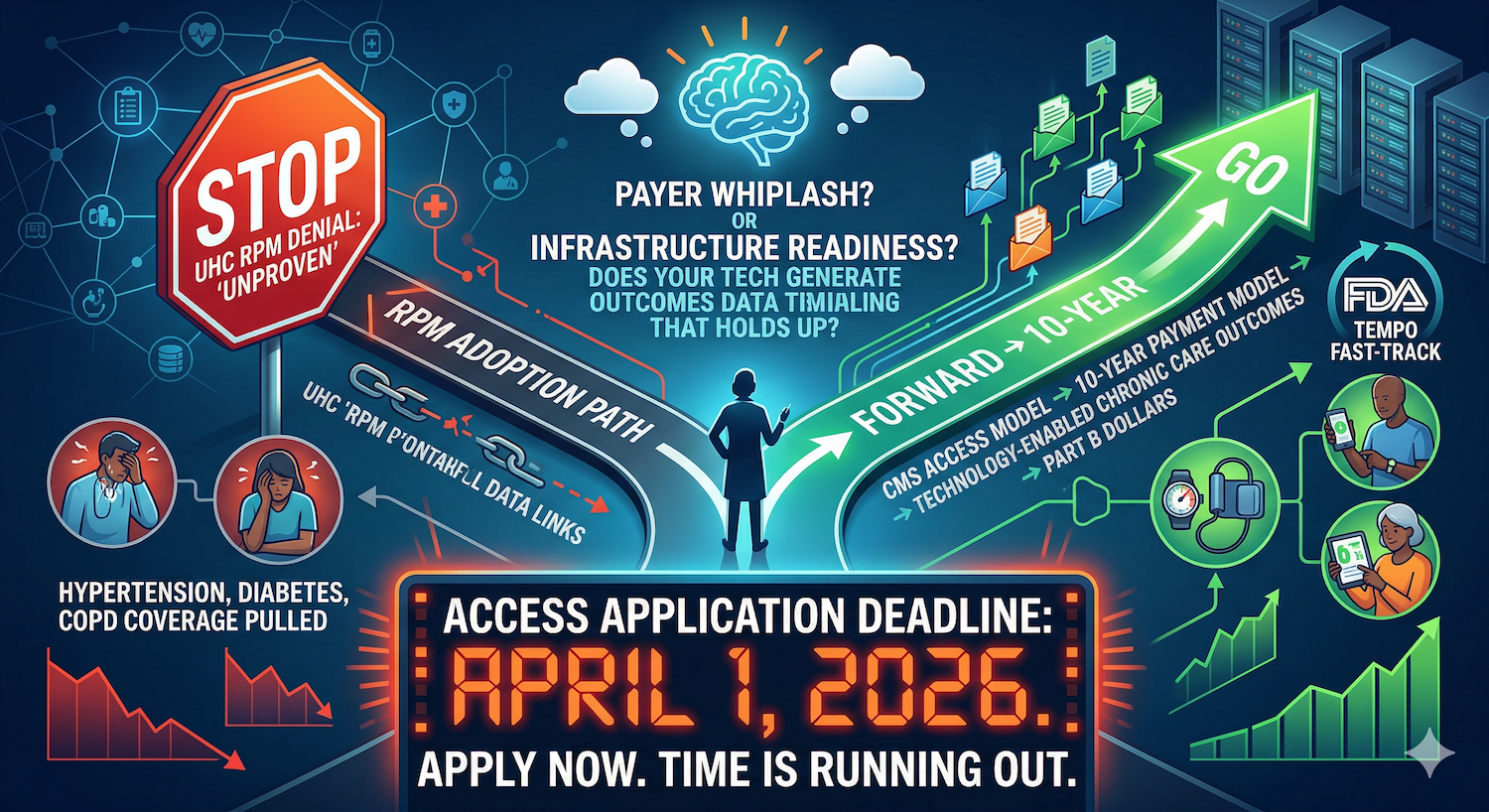
Here's the situation. UnitedHealthcare, which covers more Americans than any other insurer, announced it would strip RPM coverage for chronic hypertension, diabetes, and COPD, limiting reimbursement to only heart failure and hypertensive disorders of pregnancy. Their reasoning: RPM is "unproven and not medically necessary due to insufficient evidence." Industry pushback was immediate and intense enough that UHC delayed implementation, but the policy direction is clear.
Meanwhile, CMS and the FDA just did the opposite. The ACCESS Model -- a 10-year, outcomes-based payment model launching July 5, 2026 -- explicitly builds Medicare Part B reimbursement around technology-enabled chronic care for hypertension, diabetes, chronic musculoskeletal pain, and depression. And the FDA's companion TEMPO pilot is selecting up to ten digital health device manufacturers per condition to fast-track real-world deployment under enforcement discretion, specifically so these technologies can be used within ACCESS before traditional premarket clearance.
Two diametrically opposed signals. One says the evidence doesn't exist. The other is building a decade-long federal payment infrastructure on the assumption that it does.
The evidence isn't ambiguous. The American Heart Association, American Medical Association, and American College of Cardiology all recommend RPM for hypertension management. A Health Affairs analysis published in December 2025 directly challenged UHC's evidence claims, noting that the conclusion is "at odds with the weight of scientific evidence, clinical guidelines, federal policy direction, and years of real-world experience."
MUSC Health just launched an expanded remote blood pressure monitoring program in March 2026, targeting a state where one in three adults have been diagnosed with hypertension. They're not doing this because the evidence is thin. They're doing it because the evidence is overwhelming and the reimbursement pathway is getting clearer every quarter.
At Welby, our own data tells the same story: patients on our cellular-enabled blood pressure cuffs see a 20% decrease in blood pressure. Smart glucose monitors show a 20%+ reduction in blood glucose within four weeks. Heart failure patients using daily connected scales are 5.5x more likely to adhere to life-saving therapies. This isn't theoretical. This is what happens when monitoring is paired with licensed clinical staff and AI-powered workflows that actually close the care loop.
If you're a health system CEO or CFO, the UHC decision is frustrating but not existential. Medicare remains the primary revenue driver for chronic care management programs, and CMS just expanded the playbook significantly. The new CPT code 99445 allows billing for 2-15 days of device measurements, complementing the existing 99454 code for 16+ days. Virtual supervision now qualifies for technical component billing, eliminating the requirement that a physician be physically on-site. These aren't incremental changes. They lower the barrier to entry for every provider organization that's been sitting on the fence.
The existential question is different: are you building care delivery infrastructure that works across payer environments, or are you building programs that collapse every time a single payer changes a coverage policy?
This is where the architectural decisions matter. Organizations that built RPM programs around a single payer's reimbursement schedule are now scrambling. Organizations that built RPM as a core clinical capability -- integrated into their care management workflows, staffed with dedicated clinical teams, generating outcomes data that holds up across payer negotiations -- are in a fundamentally different position. They can absorb a UHC coverage change because their program's value isn't dependent on any single payer's decision.
This is not a drill. The first performance period for the ACCESS Model begins July 5, 2026, and the application deadline is April 1, 2026 -- two days from now.
If your organization hasn't applied, you need to understand what you're leaving on the table. ACCESS is a voluntary, 10-year model. Early participants will shape how CMS evaluates technology-enabled chronic care outcomes for the next decade. The organizations that sit this out aren't just missing a billing opportunity. They're ceding influence over the payment model that will define chronic care reimbursement through 2036.
The TEMPO pilot adds another layer. FDA is selecting digital health device manufacturers to participate in ACCESS under enforcement discretion, meaning the regulatory and reimbursement pathways are being co-designed in real time. If you're using technology-enabled care management platforms, your vendor's participation in TEMPO directly affects your ability to bill under ACCESS.
The divergence between CMS and UHC is going to accelerate vendor consolidation. Here's why.
Health systems need technology partners that can generate the clinical outcomes data required to justify reimbursement across multiple payer environments. When CMS is expanding coverage and UHC is restricting it, the only defensible position is demonstrable outcomes. Not device data. Not dashboards. Documented, auditable clinical improvement tied to specific interventions.
That requires a fundamentally different platform architecture than what most RPM vendors offer. You need monitoring integrated with clinical workflows. You need licensed clinicians who act on the data, not just review it. You need AI that prioritizes interventions based on risk stratification and surfaces the right patient at the right time. And you need all of it generating the kind of outcomes documentation that holds up in a payer negotiation or a CMS performance review.
This is what we built Welby to do. Our model pairs RN case managers with AI-powered automation across CCM, RPM, and transitional care, generating new billable revenue for our partners while producing the clinical outcomes that both CMS and resistant payers need to see.
The UHC decision is a speed bump for some and a wake-up call for others. The real story is that CMS and the FDA are building permanent, decade-long infrastructure around technology-enabled chronic care. That's where the revenue is going. That's where the evidence already points. And that's where every forward-thinking health system should be positioning right now.
The ACCESS application deadline is April 1. If you haven't applied, today is the day to start.
Seth Merritt is the Founder and CEO of Welby Health, an AI-powered care management platform that helps healthcare organizations improve patient outcomes while generating new revenue through chronic care management, remote patient monitoring, and transitional care. Learn more at welbyhealth.com.