

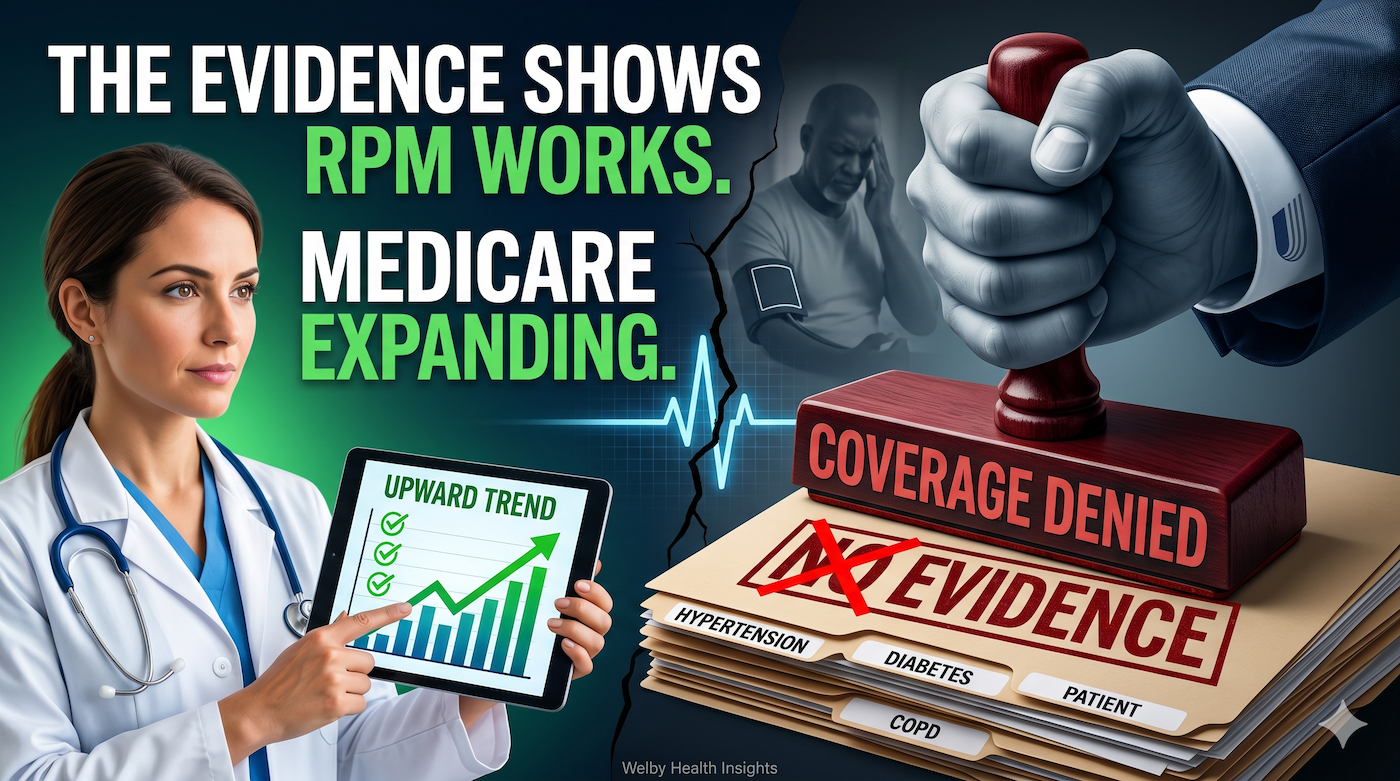

In late 2025, UnitedHealthcare announced a policy change that would have stripped remote patient monitoring coverage for millions of Americans managing chronic hypertension, diabetes, and COPD. Under the original plan, effective January 1, 2026, RPM would only remain billable for heart failure and gestational hypertension. Everything else was cut.
The industry pushed back hard. UHC delayed implementation. But the company has made it clear: they still intend to enforce this policy sometime in 2026. The official policy documents still carry the restrictive language.
This is not a footnote in a reimbursement bulletin. This is the nation's largest commercial insurer signaling that it believes remote monitoring for the most common chronic conditions has "no evidence" of value. That claim does not hold up under scrutiny, and the downstream consequences for patients and providers are severe.
A large retrospective cohort study published in Healthcare analyzed 6,595 patients on RPM programs and found systolic blood pressure improved by 7.3 mmHg across all patients and by 16.7 mmHg for those with stage 2 hypertension. After at least 90 days of monitoring, the percentage of patients with uncontrolled hypertension dropped from 66.3% to 40.2%.
Those are not marginal gains. For context, a sustained 10 mmHg reduction in systolic blood pressure is associated with a 20% reduction in major cardiovascular events and a 13% reduction in all-cause mortality, according to data published in The Lancet.
A systematic review and meta-analysis published in JMIR mHealth and uHealth found that RPM reduced hospitalizations for patients with heart disease and COPD. The American Heart Association has issued guidance supporting RPM as a tool for managing cardiovascular risk.
At Welby Health, we see this play out every day across our partner practices. Our patients using cellular-enabled blood pressure cuffs have achieved a 20% decrease in blood pressure readings. Heart failure patients in our programs are 5.5 times more likely to adhere to life-saving therapies. Patients using our smart glucose monitors have seen blood glucose reductions of more than 20% in just four weeks.
This is not a technology looking for validation. The evidence is there. The outcomes are measurable. The question is whether payers are willing to look at it.
What makes the UHC position so jarring is that it runs directly counter to the direction Medicare is heading. CMS has been expanding RPM and chronic care management support. New CPT codes introduced for 2026, including 99445 for connected device supply and data transmission, and 99470 for RPM treatment management, signal that Medicare sees remote monitoring as a permanent fixture in care delivery, not a temporary experiment.
CMS has expanded value-based payment models to cover 45% of Medicare beneficiaries and is actively experimenting with clinical AI payment codes. The federal government is betting heavily on distributed, data-driven care. UHC is pulling in the opposite direction.
For provider organizations, this creates a fractured coverage landscape that makes RPM program sustainability harder to plan around. If you have built remote monitoring into your chronic care workflows, you now face a choice: absorb the cost for UHC patients, migrate those patients into alternative billing pathways like CCM or APCM (neither of which reimburse for device setup or management), or stop monitoring them altogether.
None of those options are good for patients.
The financial logic behind UHC's decision presumably centers on short-term claims reduction. Fewer covered RPM services means fewer claims paid out in the near term. But this math ignores the downstream costs that RPM exists to prevent.
Uncontrolled hypertension leads to strokes, heart attacks, and kidney failure. Unmanaged diabetes leads to amputations, blindness, and dialysis. These are not hypothetical outcomes. They are predictable, preventable events that generate catastrophic claims.
The connected medical devices market for remote patient monitoring is projected to reach $109.44 billion by 2032, up from $36.82 billion in 2025. That growth is not speculative. It reflects a structural shift in how healthcare is delivered, driven by workforce shortages, an aging population, and the simple reality that most chronic disease management happens between office visits, not during them.
Pulling coverage for the monitoring tools that catch problems early does not save money. It shifts costs downstream and onto sicker patients.
If you are running or considering an RPM program, the UHC delay gives you time, but not certainty. Here is how I would think about it.
First, diversify your payer mix for remote monitoring. Do not build an RPM program around a single payer's willingness to reimburse. Medicare remains supportive. Many state Medicaid programs are expanding coverage. Build your program on the most durable reimbursement foundation available.
Second, pair RPM with chronic care management. The combination of remote monitoring and licensed clinical support creates a care model that generates revenue across multiple CPT code families, not just RPM. At Welby, our licensed RN case managers work alongside AI-powered workflows to manage patients across CCM, RPM, and TCM simultaneously. That model is resilient because it does not depend on any single billing code.
Third, document outcomes aggressively. The best defense against payer rollbacks is irrefutable data. Track blood pressure trends, A1C changes, hospitalization rates, and medication adherence for every patient in your program. When the next coverage fight comes, and it will, you need the numbers.
The UHC decision is frustrating, but it is not the trend line. Medicare is expanding support. The evidence base is growing. The market is moving toward distributed, technology-enabled chronic care at scale.
The providers who build durable programs now, ones grounded in clinical outcomes and diversified reimbursement, will be positioned to thrive regardless of what any single payer decides. The ones who wait for every payer to agree before they act will be left behind.
Remote patient monitoring works. The data proves it. The patients living it know it. The only question is whether the largest commercial payer in the country will catch up to the evidence before more patients fall through the cracks.