

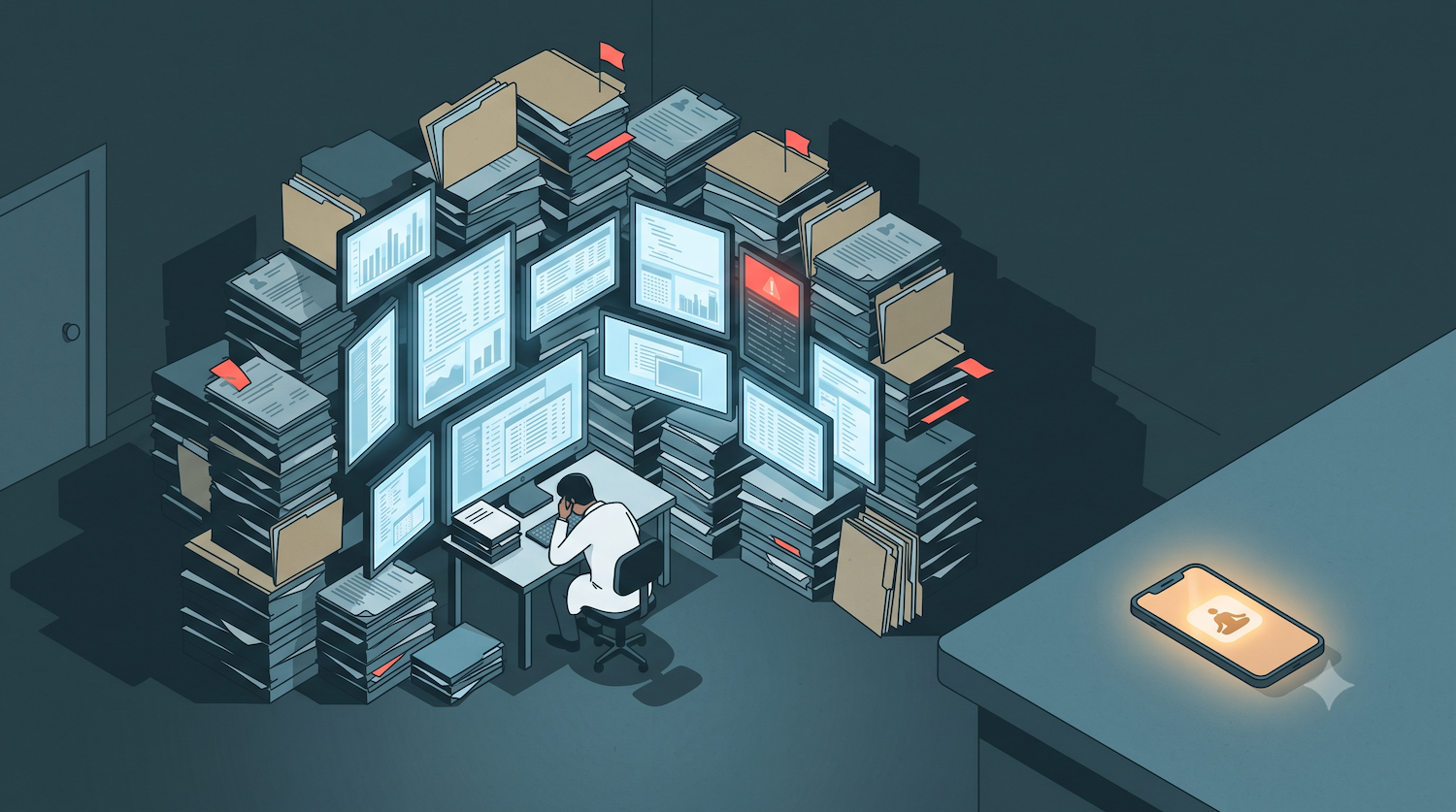
The AMA put out its latest physician burnout numbers and the wellness industry got to feel good about itself. Burnout dropped to 41.9 percent in 2025, down from 43.2 the year before and 48.2 the year before that. Fourth straight year of decline. Cue the press releases about resilience programs and chief wellness officers and the meditation app you rolled out at the last town hall.
Here's what nobody running one of those programs wants to say. We are still telling roughly four in ten doctors that they're burned out, and we're treating it like a personality flaw they can yoga their way out of. It isn't. It never was. Burnout is a workload problem wearing a wellness costume, and you can't fix a workload problem by teaching tired people to breathe better.
Look at where the burnout actually concentrates and the story tells itself. Emergency medicine, urological surgery, and heme/onc are still sitting near 50 percent. Infectious disease is at 23 percent. Nephrology under 30. (Those are the AMA's specialty figures, worth a quick check before anybody quotes them in a board deck.) If burnout were really about individual grit, it would scatter randomly across personalities. It doesn't. It pools exactly where the work is heaviest and the team is thinnest. That's not a coincidence. That's the whole answer.
And the AMA's own research basically admits it. A study in JAMA Internal Medicine, led by Lisa Rotenstein, looked at 970 physicians across 15 organizations. Nearly half said they worked on an incompletely staffed team more than a quarter of the time. Those doctors were more than twice as likely to be burned out. In that same group, almost 48 percent met the criteria for burnout, a quarter wanted to cut their clinical hours, and 15 percent were planning to walk out the door inside two years. Read that line again. The single biggest lever on burnout in that data wasn't mindset. It was whether you had enough hands on the team. (Verify those exact percentages against the JAMA paper before publishing, but the direction is not in question.)
So why does every health system reach for the resilience binder first? Because it's cheap and it's flattering. A workshop costs a few thousand dollars and lets leadership say they did something. Admitting your care model dumps ninety days of chronic-disease management onto a physician who has twelve minutes and no support staff costs a lot more, and it points the finger back at the org chart instead of the doctor. One of those conversations is comfortable. The other one is true.
I'll tell you what I learned building these programs from the payer side for years. We loved a wellness initiative. It was a great line item. It signaled care without changing a single thing about how the work flowed. The doctor still went home with the same inbox, the same panel, the same patients who got confused about their meds the second they left the building. We just gave her an app to feel calmer about it. That's not support. That's a sedative.
Here's the part that should bother you most. We are doing this into a shortage. The AAMC has projected the country could be short up to 86,000 physicians by 2036. (That's their projection, and projections move, so treat it as a planning number, not gospel.) You cannot hire your way out of that. Hiring sprees aren't financially realistic for most groups even today. So if more bodies isn't coming to save you, the only honest move left is to change what lands on the body you already have.
That means pulling work out of the visit that never needed a physician in the first place. Sutter Health did a version of this with documentation help and cut physician EHR time from about 55 minutes a day to 47. A 14 percent drop, just from taking notes off the doctor's plate. Now extend that logic past charting. Most of what burns a primary care doctor out isn't the office visit. It's everything that happens after. The medication reconciliation. The blood pressure nobody checked for three months. The diabetic who needs a real human call on day forty, not a portal message she'll never open. That work is constant, it's relentless, and almost none of it requires an MD in the room. It requires a nurse, a care coordinator, and a system that reaches the patient at home between visits.
When you move that work off the physician and onto a team built to do it, two things happen at once. The doctor stops drowning, and the patient actually gets managed. The same redesign fixes the burnout number and the readmission number. They were never separate problems. We just funded them out of separate budgets.
What do you do Monday morning? Stop measuring your wellness program by attendance. Nobody was ever saved by showing up to a webinar. Measure something that matters. Pull your primary care panels and count how much of each physician's week is spent on work a trained team member could own instead. Between-visit outreach, chronic care follow-up, documentation, refill management, the endless administrative tail. If that number is big, you don't have a resilience problem on your hands. You have a design problem, and no amount of gratitude journaling is going to touch it.
Then ask the harder question. Can your practice realistically staff and run that between-visit care itself, with your own nurses, on your own EMR, while your physicians are already underwater and you can't find people to hire? For most groups the honest answer is no. That's fine. That's exactly the work that gets handed off to a partner who runs it end to end and gets paid out of what actually gets billed. The point isn't who does it. The point is that it comes off the doctor's plate and lands somewhere it can be done well.
I'm glad the burnout number is going down. I just don't think a meditation app moved it, and I don't think the next two points come from one either. The doctors who aren't burned out are the ones who aren't carrying work that was never theirs to carry. Build the team that takes it off them, or keep buying apps and wondering why your best physician just gave notice.
Sources:
